Lead Content Specialist and Designer for TNEEL Team at the University of Washington (UW): Finalized easy-to-access, teacher/learner-friendly content for CD-ROM titled Toolkit for Nursing Excellence at End of Life Transition. Additionally, led design, architecture, and content build of TNEEL SS and TNEEL APA websites with focus on unique user experiences.
Funded by a $1.6 million Robert Wood Johnson Foundation grant and initiated at the University of Washington, our successful marketing and coast-to-coast distributional achievements depended on engaging visual content and professional marketing brand identity that I created. As a team, we revolutionized how end-of-life care was taught to nurses and healthcare providers.
Creative, UX/UI, and Communications Duties Include:
• Designing/developing premier online course (TNEEL SS) to deliver TNEEL end-of-life content for continuing education (CE) credit
• Developing innovative TNEEL American Psychological Association (APA) online course, involving the journey mapping, user flows, and mockups
• Art direction and graphic design of all collateral marketing
• Packaging design (includes contracting with 3rd party manufacturers)
• Editing educational and multimedia material
• Creating 1000+ individual teaching slides
• Screenwriting (six scripts total)
• Meeting defined deadlines while multitasking audio-visual projects and multiple programs (Photoshop, Illustrator, InDesign, Premiere, ACID Audio, PowerPoint)
UX/UI Work for TNEEL: Both TNEEL SS and TNEEL APA utilized my unique skills in user experience (UX) and user interface (UI) design. I rebranded TNEEL in an education course for the American Psychological Association, creating an ethereal "kites" and "balloon" sky theme targeted for psychologists. This involved detailed research, journey mapping, mockups, and building wireframes for programmers to follow. The user experience of the TNEEL APA course design is based on the highly regarded Kolb experiential learning theory, allowing learners to choose from three different pathways.
Our team followed a process similar to the agile software development cycle and best practices UX design methods were adhered to. The creative and IT key players worked side-by-side solving many key technical hurdles.
Go hereor scroll down this page to see the green and blue TNEEL APA website designs.
This work continued with nationally renowned lead researcher Dr. Diana Wilkie at her company eNURSING and at the University of Illinois at Chicago (UIC), with a working relationship lasting 18 years total. Dr. Wilkie also remains my top reference.
Legacy Website: tneel.uic.edu/tneel-ss (demo link)
Go here for more TNEEL samples, video & content, including further examples of UX/UI design
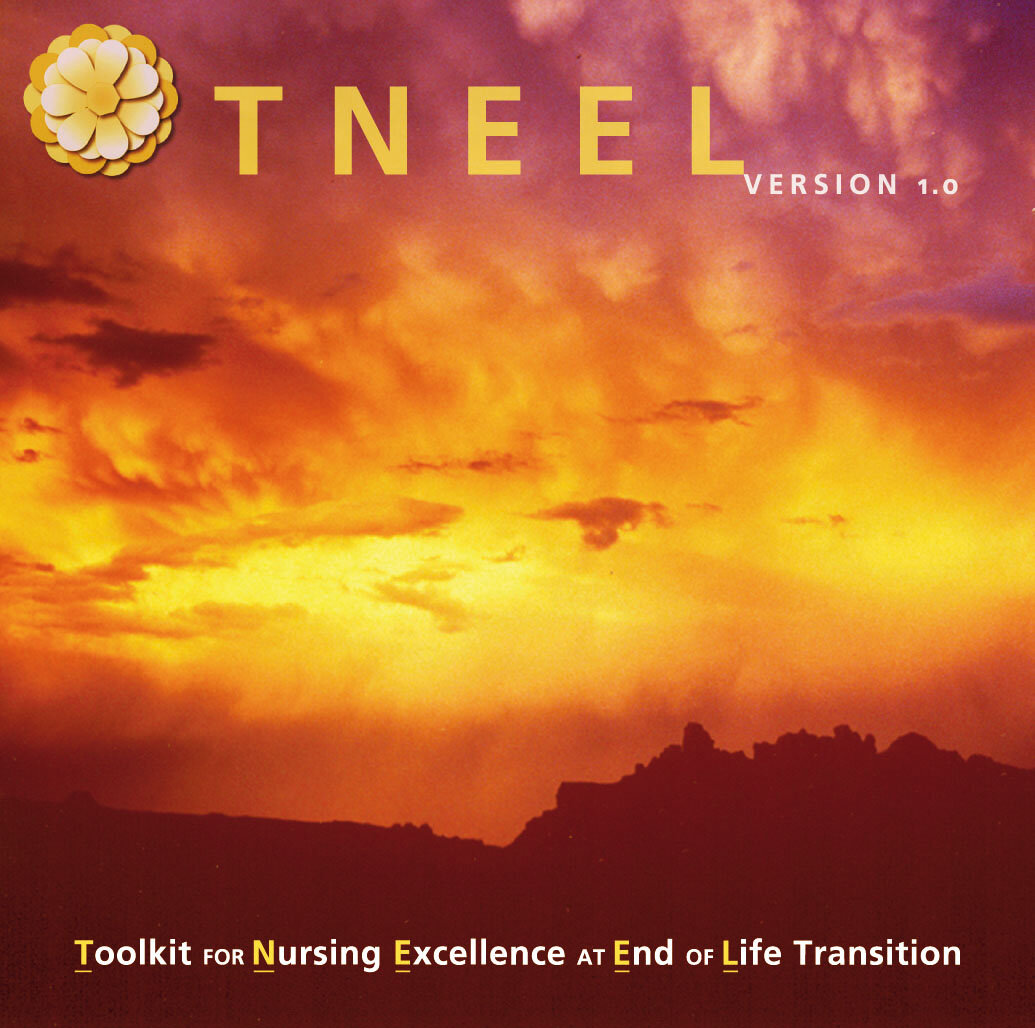
CD Jewel Case Cover & Instructions Design: Where the TNEEL Brand Began
My immediate response to the digital education content, which graphically was more than a little dated (1990s teal!) by the time I was brought onto the grant project dedicated to transforming end-of-life care in the U.S., was straight-forward. I asked, “Can we at least change the visual direction for the marketing?” The answer: “Yes, go for it.” So I did.
Scroll down for my UX/UI designs for TNEEL APA where I kept green and blue separated. As they should!
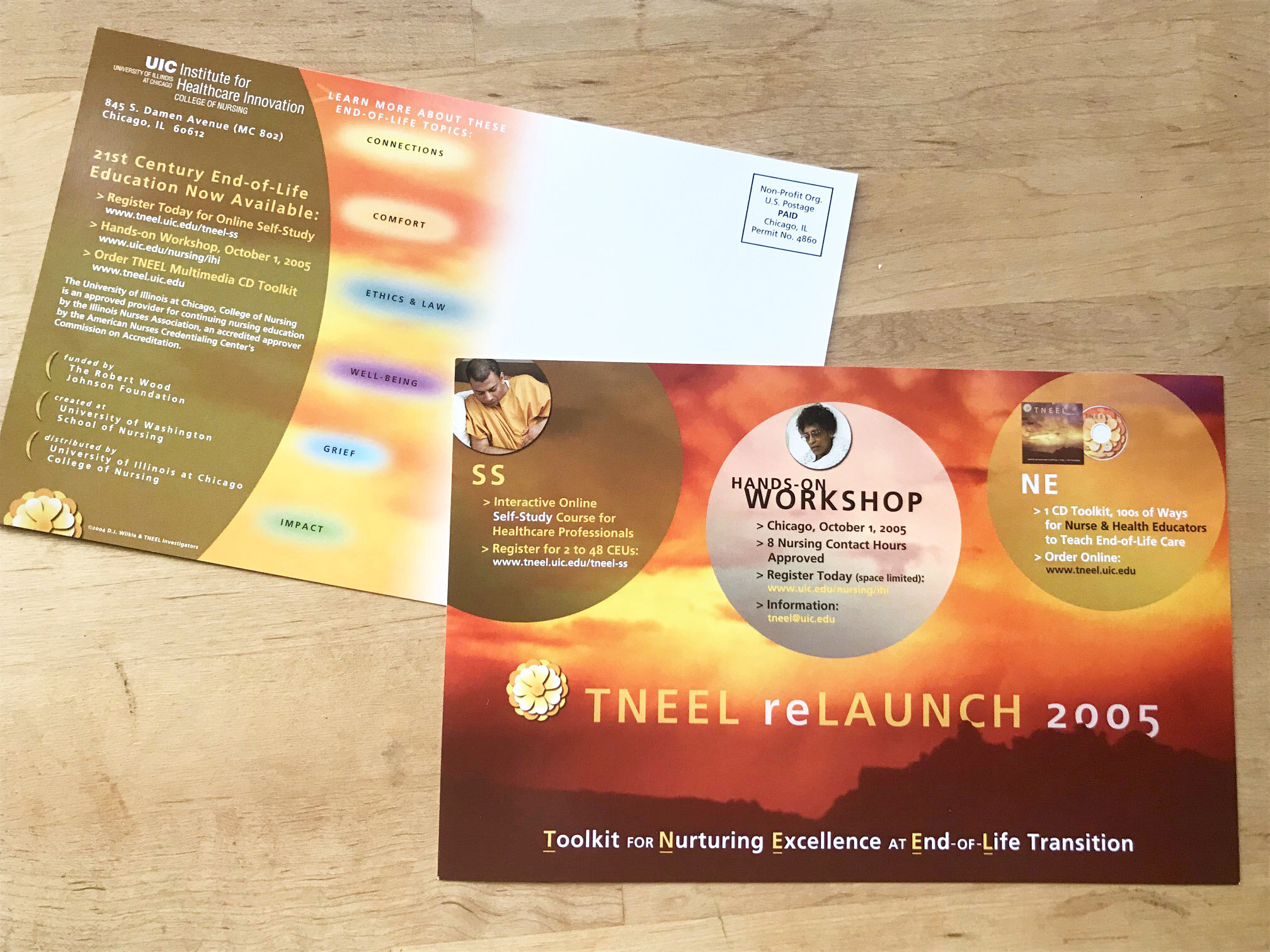
TNEEL: Improving Healthcare Nationwide with Innovative Technology and Marketing
As a result of our highly successful marketing campaign, we shipped nearly 10,000 free or at-cost CD-ROM software units to all U.S. academic and diploma nursing schools, as well as clinical agencies, hospitals, healthcare institutions, and social service agencies. This was achieved through an innovative brochure mailer (shown below). The brochure folded out into a poster with a call-to-action order form, making this my last design piece with more "snail mail" orders than online orders, and was sent to tens of thousands of addresses culled from finely tuned mailing list. This was instrumental to achieving the grant's goals, all of which were met.
4-year TNEEL Grant Goals: To improve United States end-of-life care by integrating cutting-edge multidisciplinary teaching content and electronic tools into nursing education. I was a core team member as we accomplished this ambitious national healthcare-changing goal via traditional CD-ROM technology (TNEEL NE) and continuing in 2003 as an online self-study learning platform (TNEEL SS). This work expanded to psychologists in our TNEEL APA e-learning project.

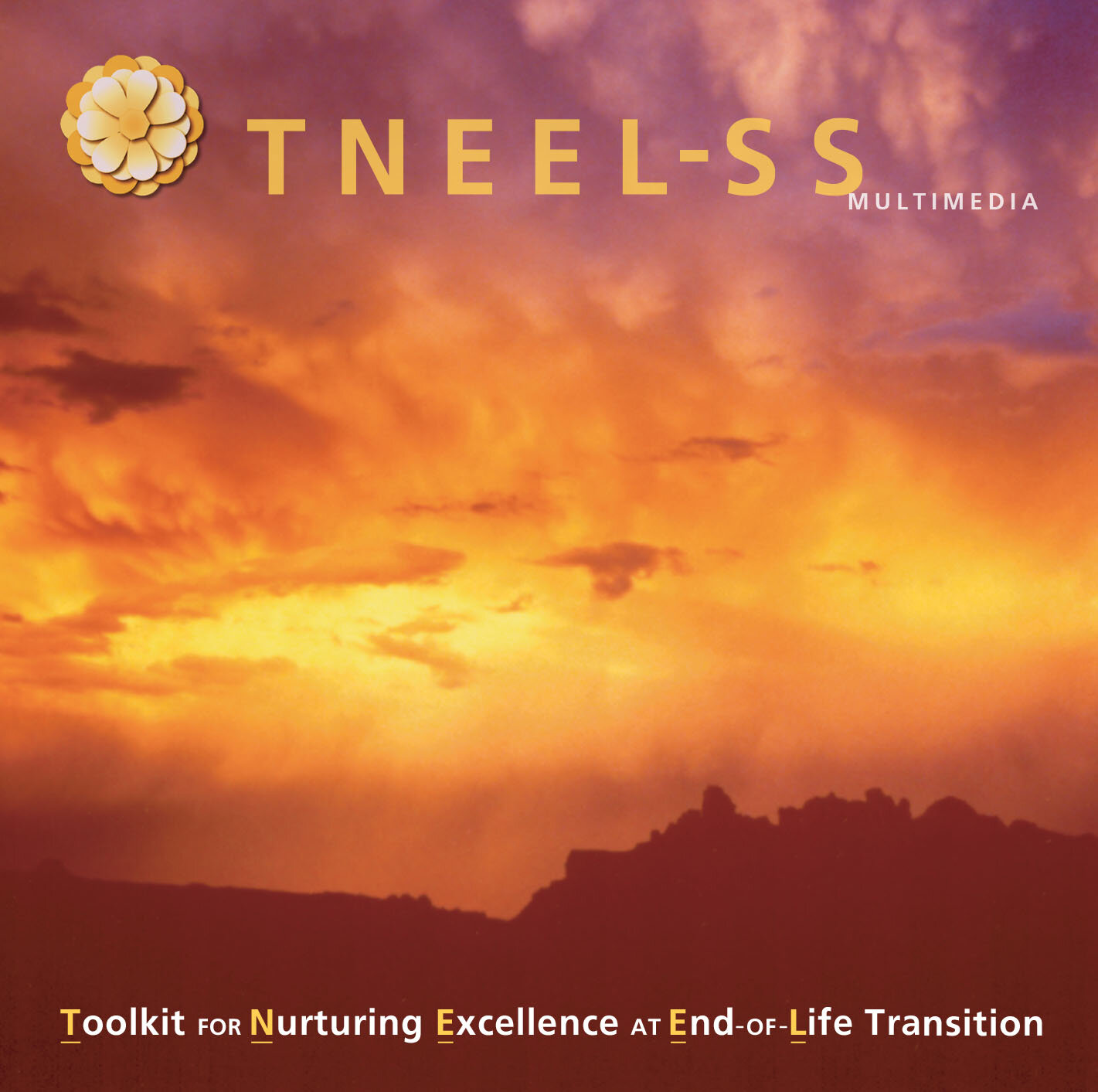
Skies Over Utah
I increased the gamma levels on Photoshop, but it’s not altered significantly. This is easily the best photo I’ve been lucky enough to work on, and I’ve used it as the central TNEEL branding image for more than a decade.
PHOTO CREDIT: My longtime mentor and supervisor Dr. Diana Wilkie's late husband, Barlow. Together I heard of their many adventures exploring nature in the West — and I was given free reign to use his photos before and after his passing. Many of his best high quality slides I would scan and use in an innovative multi-pathway user interface design for a Palliative Care Learning website at the University of Illinois at Chicago.
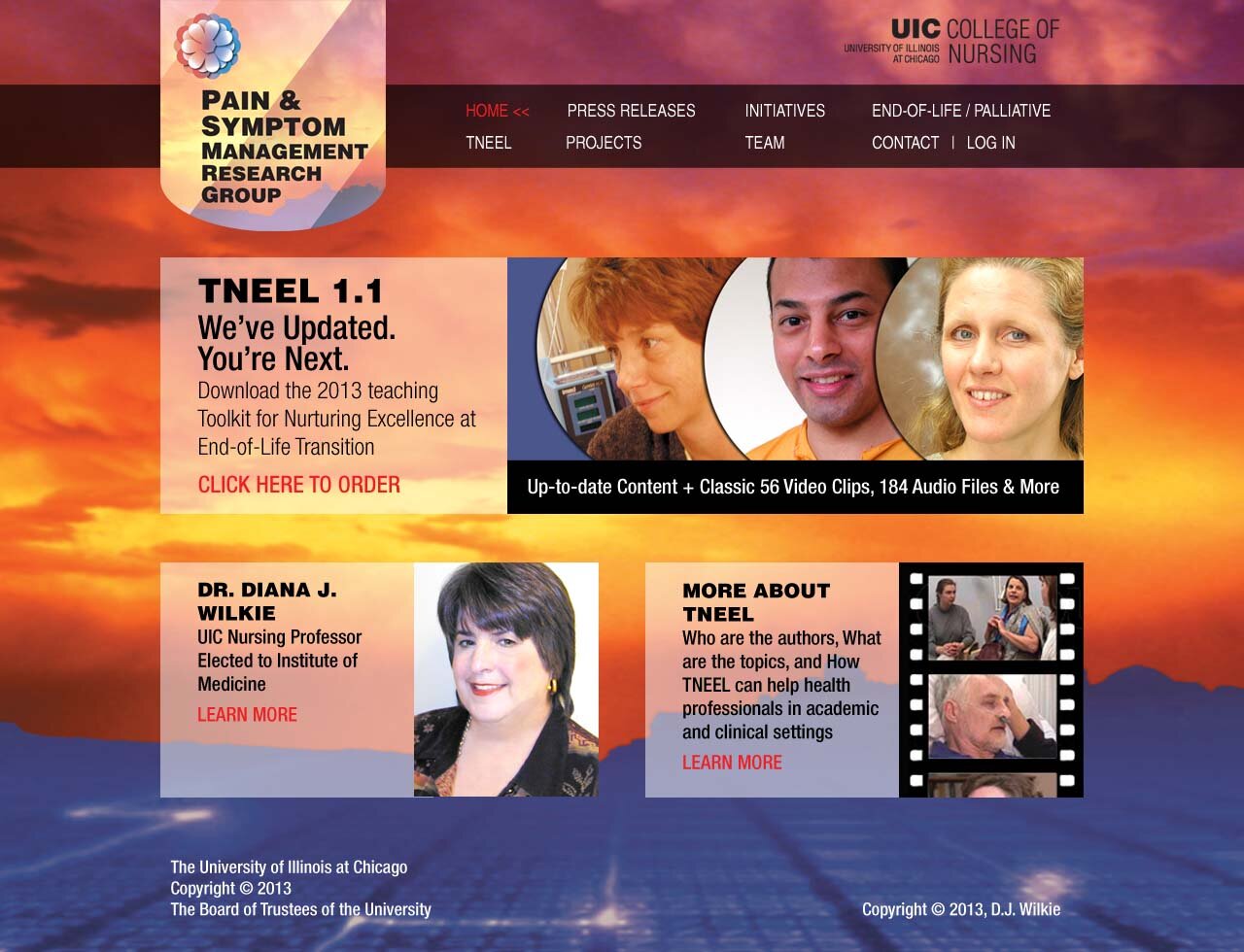
Design for TNEEL Update in 2013
Diana Wilkie's UIC Website was also set up to purchase and download her TNEEL software update. Project was eventually put on hold, but I created wireframe, all design work, and prototype:
research.nursing.uic.edu/Tneel/

UX/UI Design Work: TNEEL APA Online Course (for the American Psychological Association)
These user experience concepts were groundbreaking in digital-based education.
The Problem: How do you get psychologists to engage with your content and site in an intuitive manner that best maps onto the user’s preferred learning method?
The Solution: The evidence-based Kolb model of learning allowed for several entry points into the content based on the unique learning style of the user. Kolb wrote: “Learning is the process whereby knowledge is created through the transformation of experience.” UX designers today continue to be inspired by David Kolb’s evidence-based framework and holistic integrative methodology.
Also, research indicated we needed a design that was ethereal and beautiful. And we got the go-ahead by stakeholders that we could change the brand imagery from what we had created for TNEEL previously.
We kept the sky. But went with the blue and green. This wasn’t a Seahawks thing, even though the project ostensibly started in Seattle.
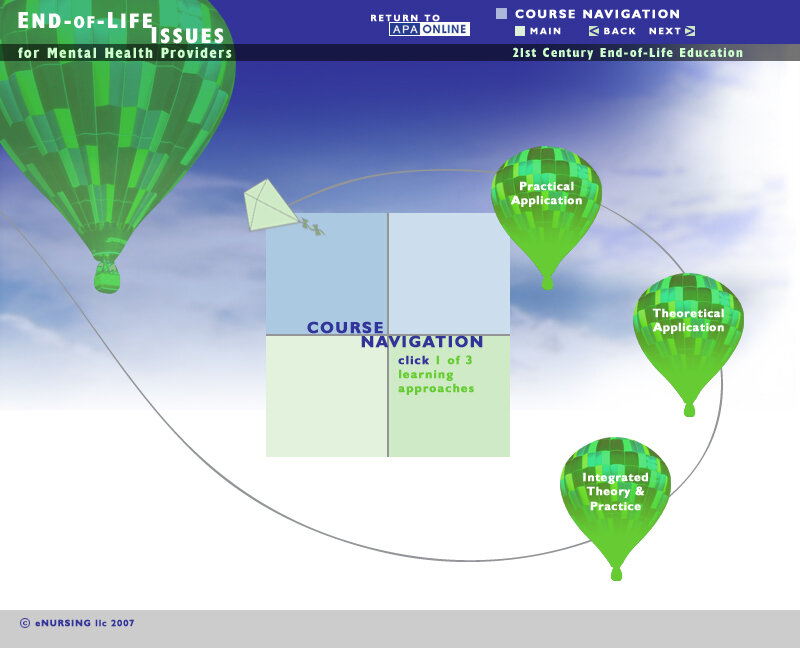
Intuitive Navigation
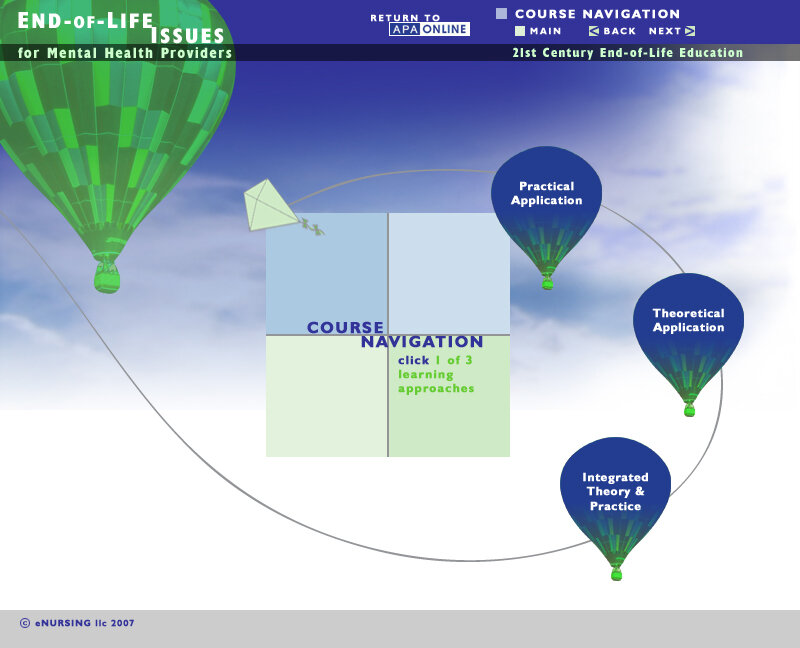
Utilizing the Kolb learning model, we could give the user the option of engaging the content via three different pathways. This model helped in our development of user flows, which guided programmers and developers in completing this project on time with the user’s learning choices front-and-center.
Additionally, an intentional process of empathetically considering the visual motifs that would most resonate with psychologists led to these designs. Kites. Clouds. Balloons. Based on the feedback from APA leaders in Washington DC who signed off on the continuing education modules and promoted to their membership, it worked.
UX Development Steps: Research, Analyze, and Design (then Implement, Test, and Maintain)
Lesson in user experience (before it was called UX): Research (a lot) and then harness that knowledge in the design process to find out what works best for the user. Journey mapping was key to this process. Also, follow the agile software development cycle for maximum efficiency and success.
Talk to your users. Listen to your users. Think like your users.
Click here for more pages.
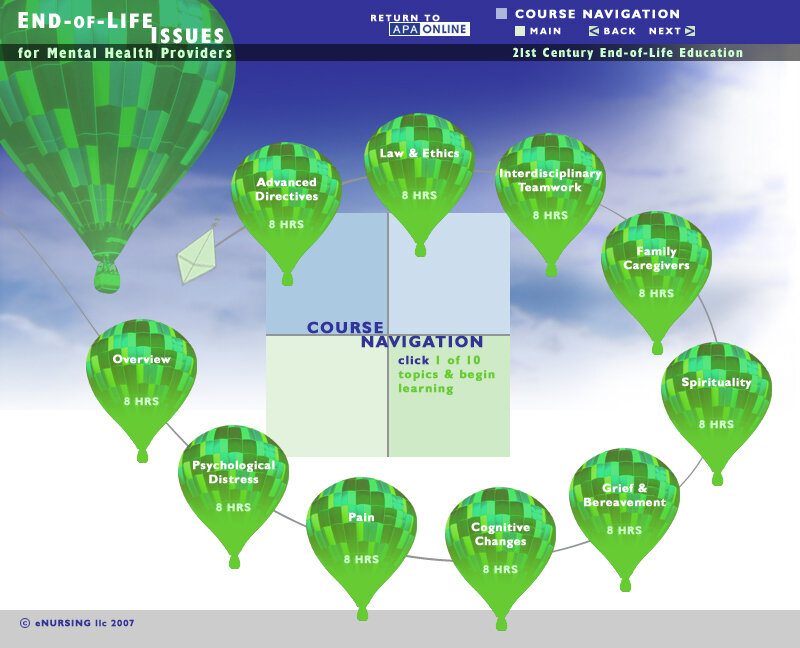
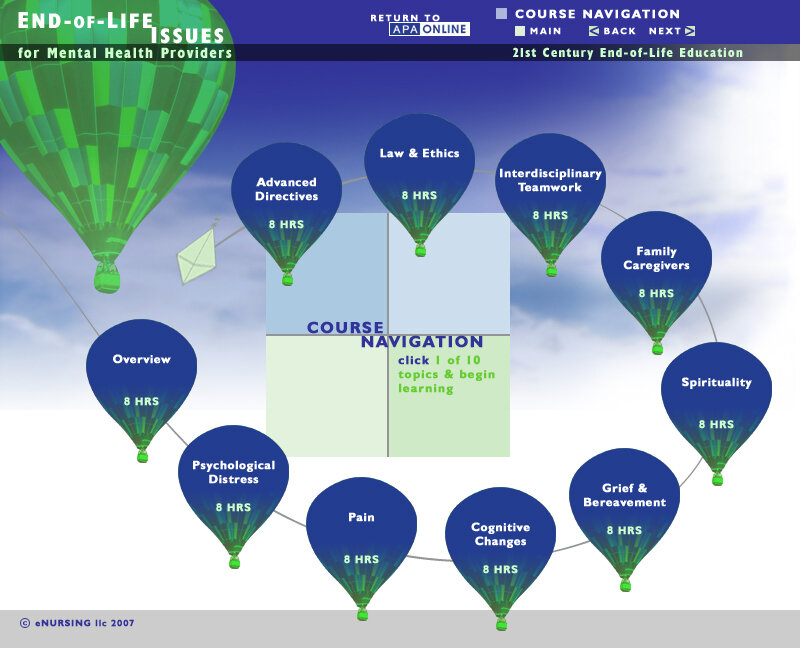
Prototype Templates for TNEEL APA Rollover Navigation
When the user landed on a learning area, the navigation at the top lit up green. They could also click on the balloons to navigate. The user could also easily track their progress through the Kolb-based educational site, which they pre-selected based on an assessment of their learning preference. These templates were sliced up for HTML programming.
Alas, the TNEEL APA website is no longer live.
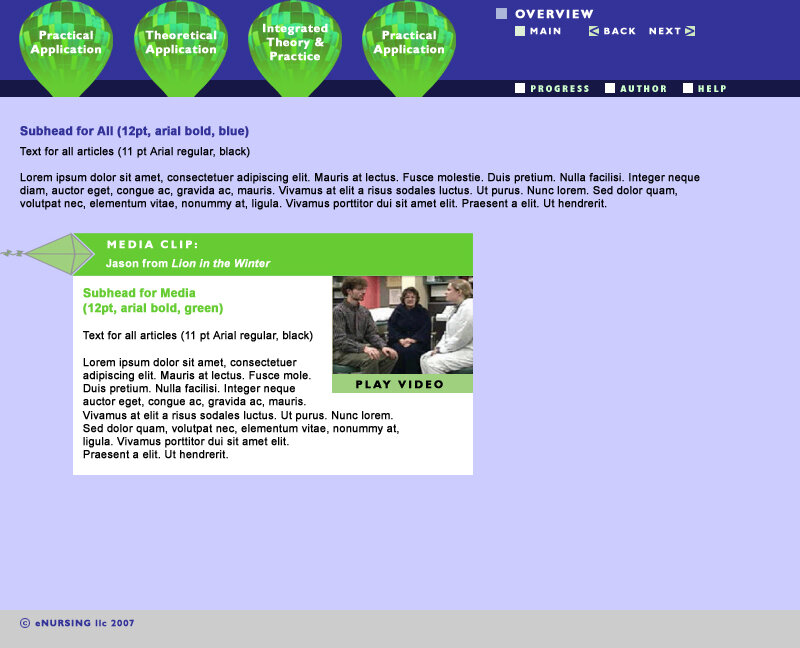
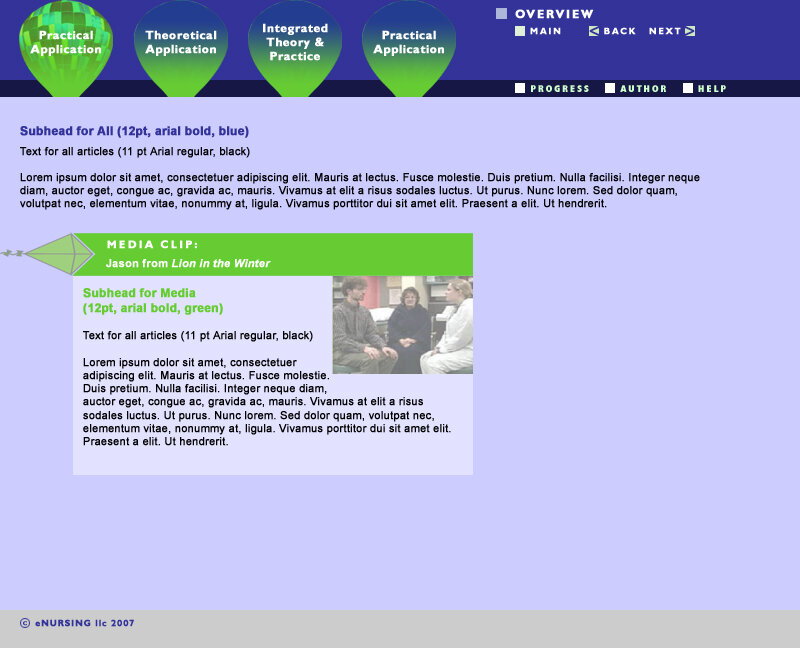
Media Clip: Audio or Video Illustrated Rich End-of-Life Content
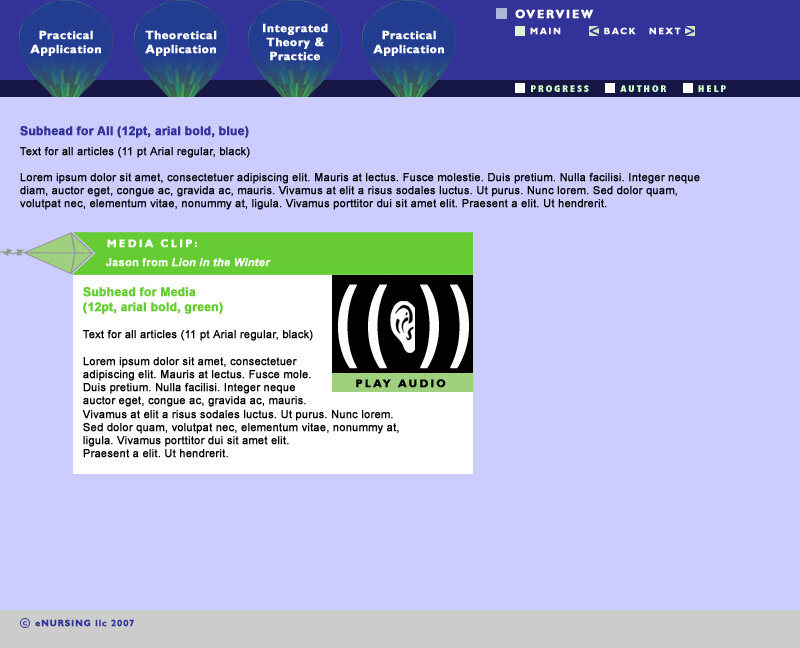
Prototype Template for Final Roll Over of Learning Pages (Turns Blue)
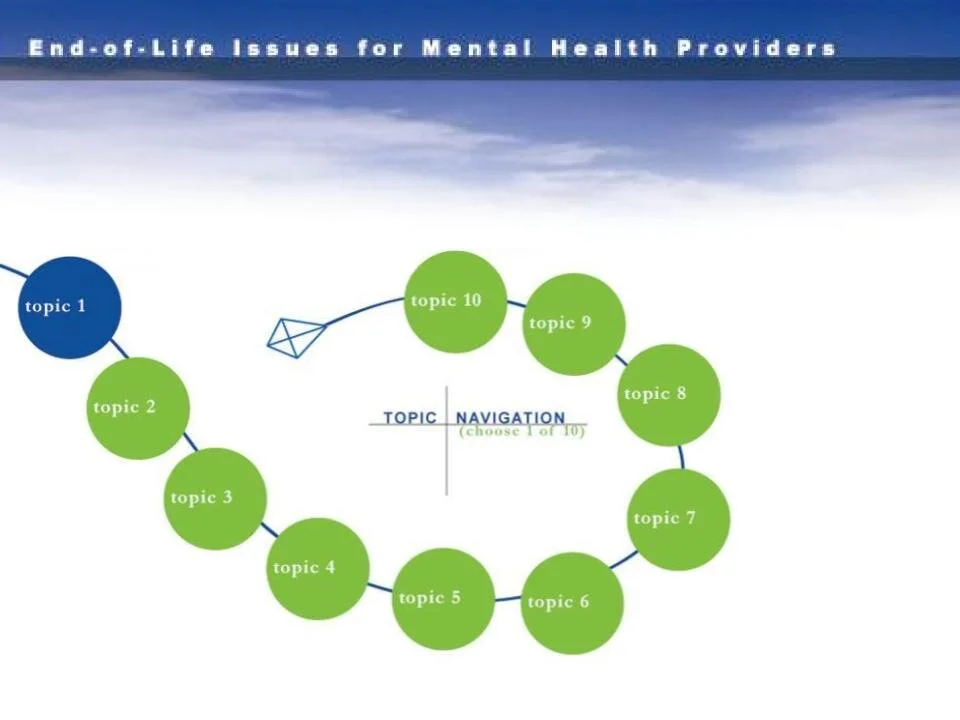
Wireframe and Navigation Template
Stakeholders, would-be users, and programmers all gave input on early concepts. Then they were fine-tuned to figure out the user interface (UI) necessary to accomplish TNEEL APA’s goals. See the project folder with additional wireframes and mockups on a slideshow here.

Early Wireframe of Homepage

Early TNEEL APA Mockup Design Highlighting the Kolb Learning Model
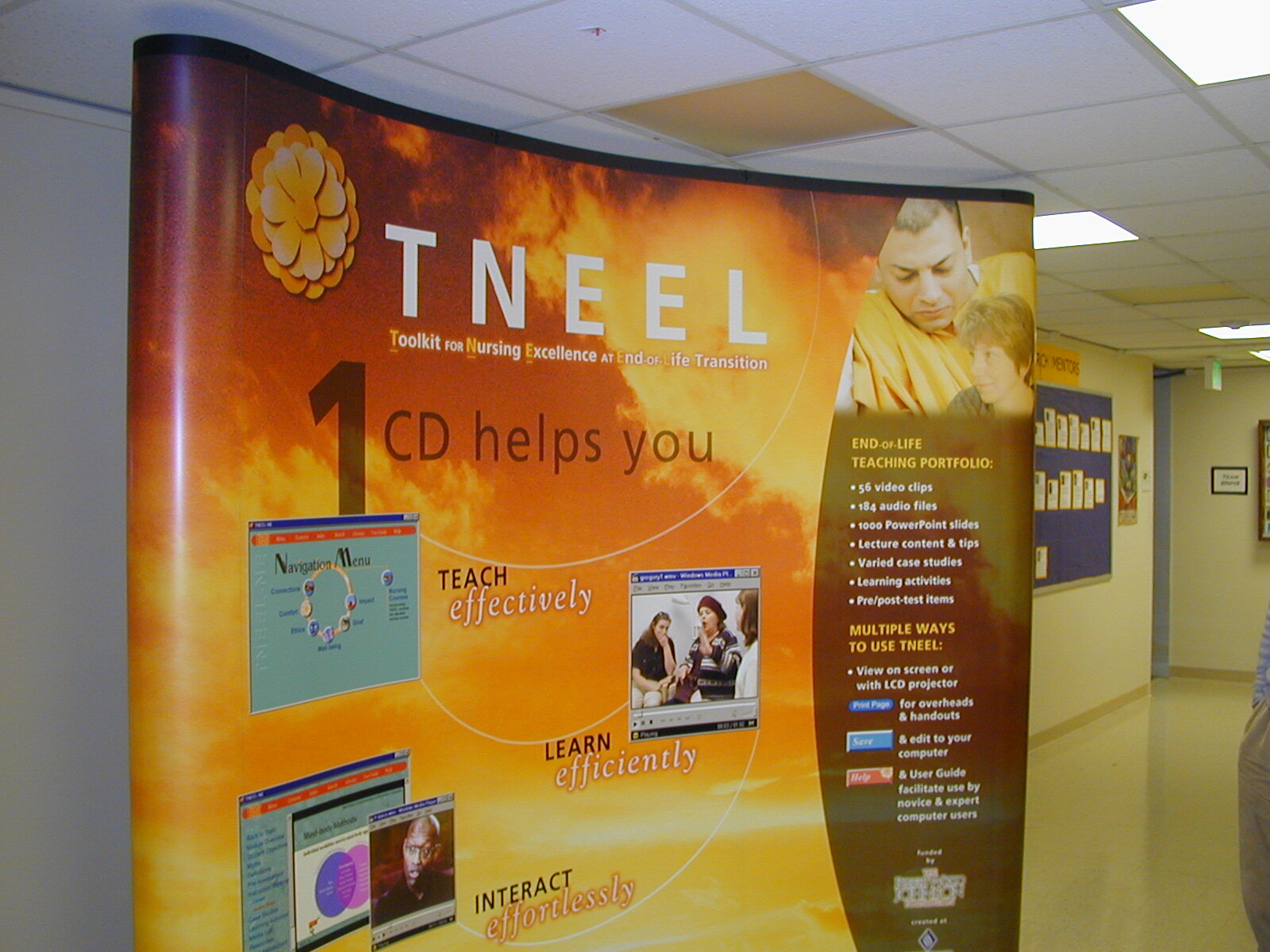
TNEEL Branding: Sunsets From Coast to Coast
Ethereal orange skies and sunsets, representative of end-of-life and transition, remained the main visual theme over several years for TNEEL. Workshops and demos from California to Washington DC took place to promote the software toolkit, often with this 10' x 8' conference trade booth in tow. I sometimes delivered workshop technical tutorials myself, including in Orlando and Albuquerque.
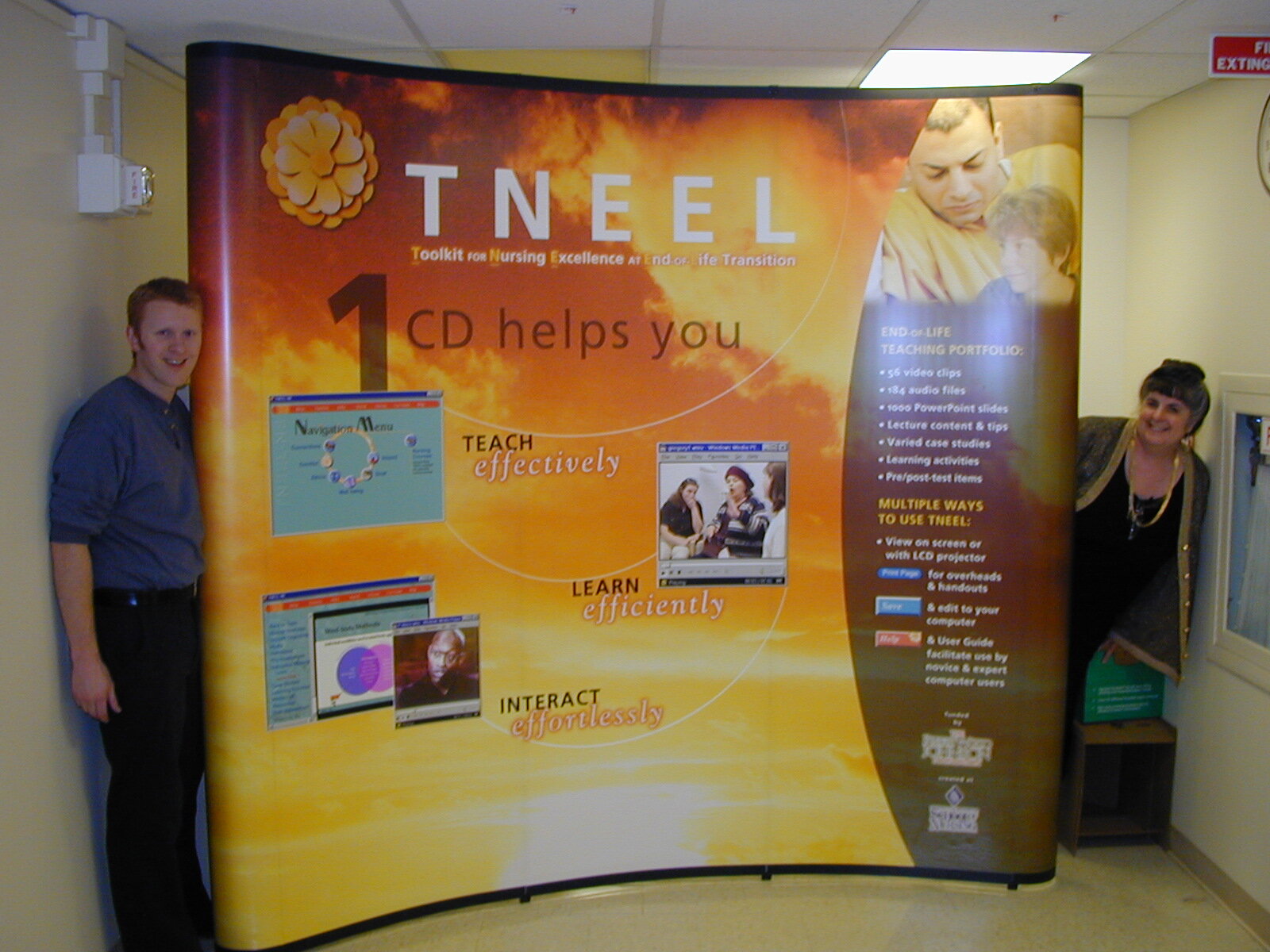
Of Course, Dr. Wilkie and I Took this Legacy Photo
Side note: My hair was much shorter in those halcyon days in Seattle.

Where Dr. Wilkie and TNEEL Authors Went to Spread the Word
I went to Albuquerque, New Mexico, for a conference and workshop one week apart. But in-between I went to the awe-inspiring International Balloon Festival, where I definitely got the idea for TNEEL APA’s balloon theme. I also did a solo climb of the tallest peak in New Mexico on that trip, and at around 12,000 feet or so I dreamed up the name “Organica Design” for my design style and company name.
I blame the endorphins and lack of oxygen. And my love of nature.
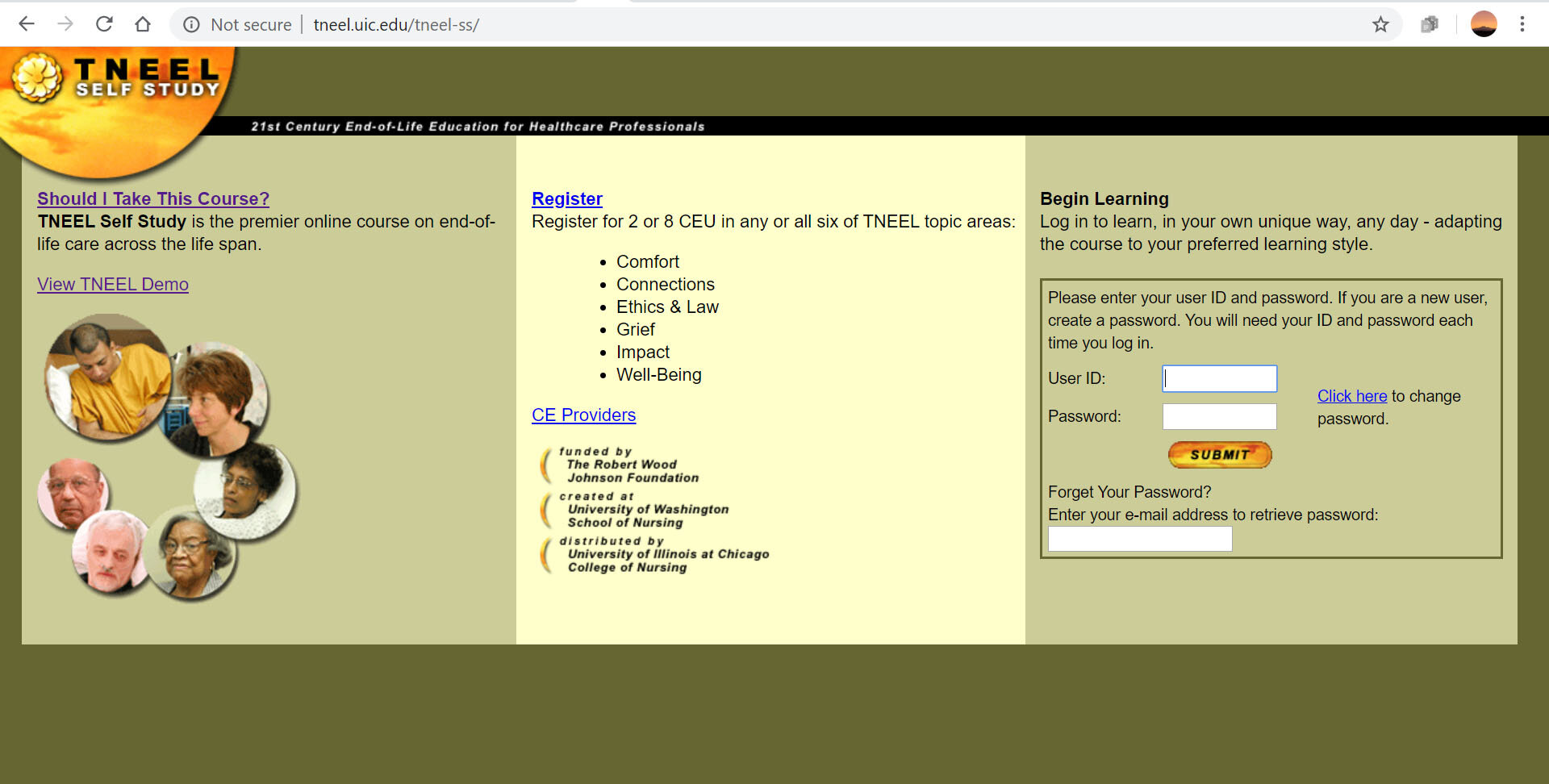
First UX/UI Design Work: TNEEL SS for Nurses and Healthcare Professionals (2003)
The Problem: How do we engage nurses and healthcare professionals with content that is more than just text and imagery? How do we avoid a linear (a.k.a. boring) textbook-like progression?
The Solution: We opened up 6 paths (a.k.a. choose-your-own chapters) with their own dynamic, multimedia content.
More About the Project: TNEEL was a multi-year $1.6 million grant funded by Robert Wood Johnson Foundation focused on improving United States end-of-life care by integrating cutting-edge multidisciplinary teaching content and electronic tools into nursing education. It offered 6 pathways to learning, with audio and video tailored specifically for the target audience. All approaches were evidence-based, including instructional design, colors, and visual elements. Each topic area possessed its own hue, iconography, and nature-based imagery, and this is where my concepts of “organic minimalism” first started to take shape in the digital world. Team was founded by Dr. Diana Wilkie.
Legacy Website: tneel.uic.edu/tneel-ss (demo link)

Screenshot of TNEEL SS Rollover Navigation
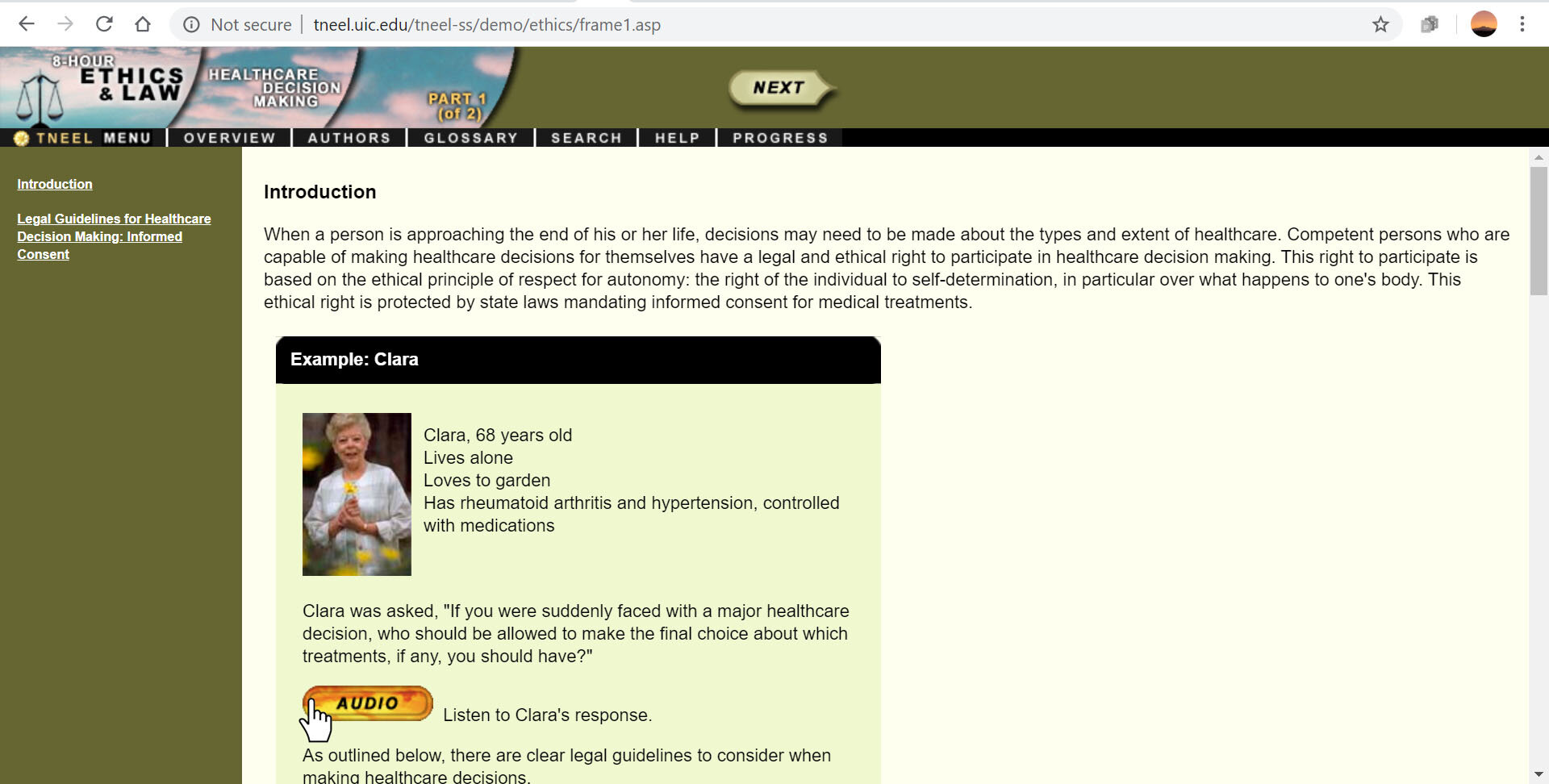
Screenshot of TNEEL SS Learning Page with Media

Screenshot of TNEEL SS Rollover Navigation
Colors match theme of each learning topic.
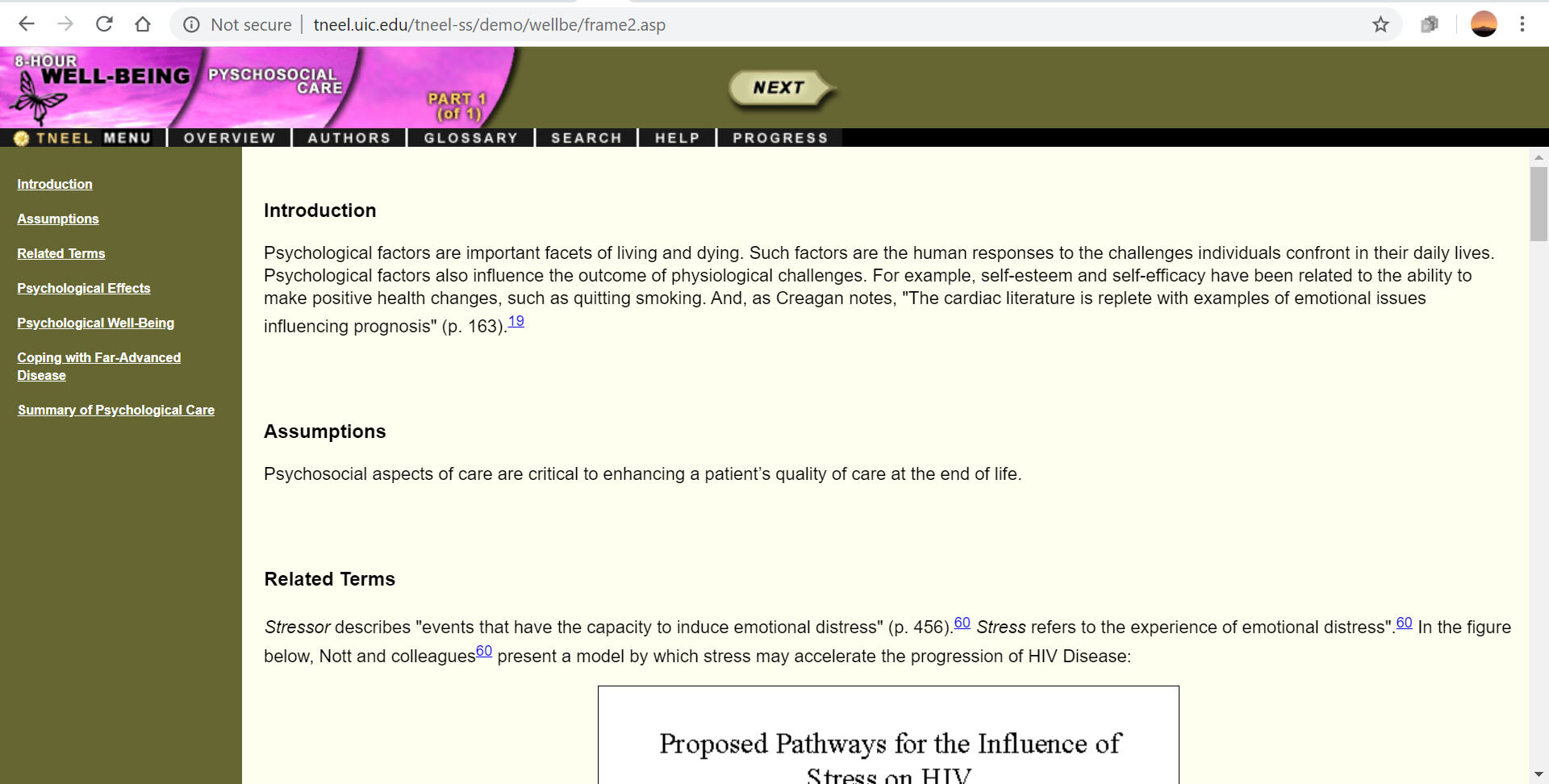
Screenshot of TNEEL SS Learning Page

Color Template for TNEEL SS
This is the fun part.

Early Iconography Mockups

Slices for Developer (Early Draft)
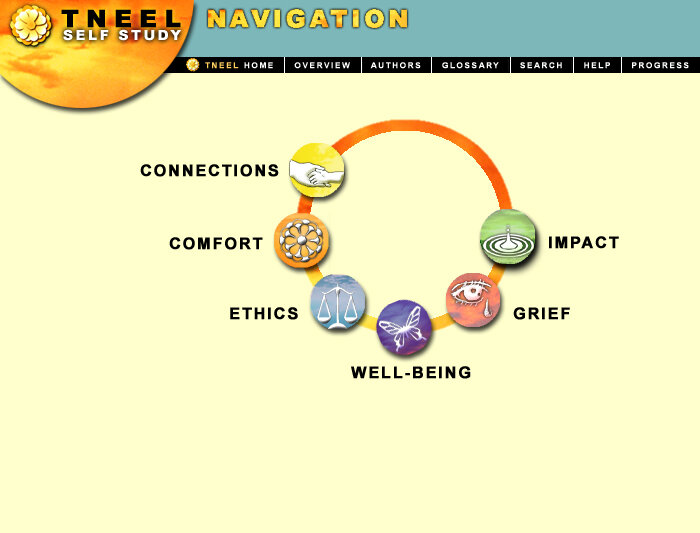
Main Navigation (Early Draft)

Video Stills of TNEEL Videos
I wrote six scripts, and assisted in directing and audio editing. I also cast all the actors. Low rez videos available here.
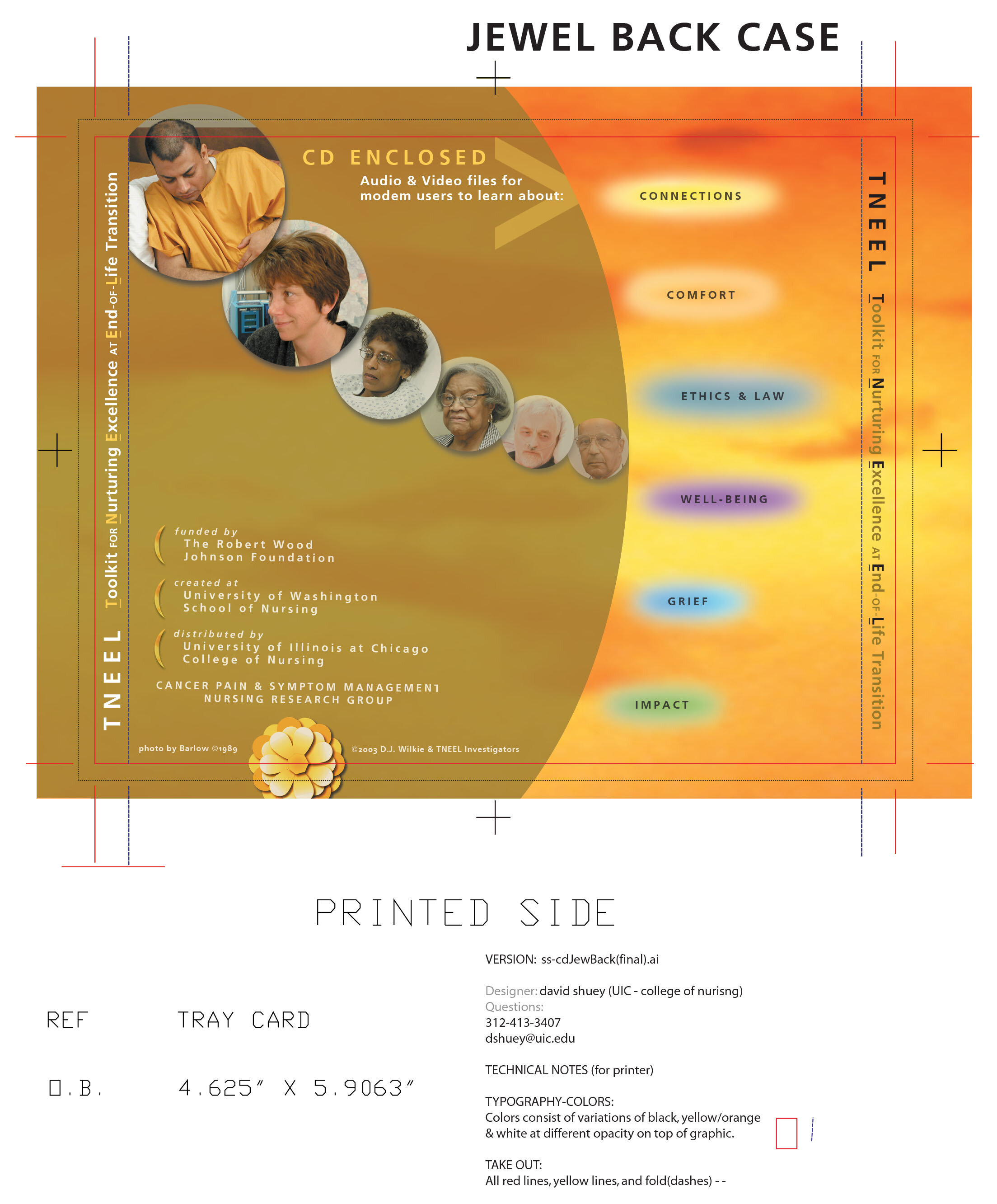
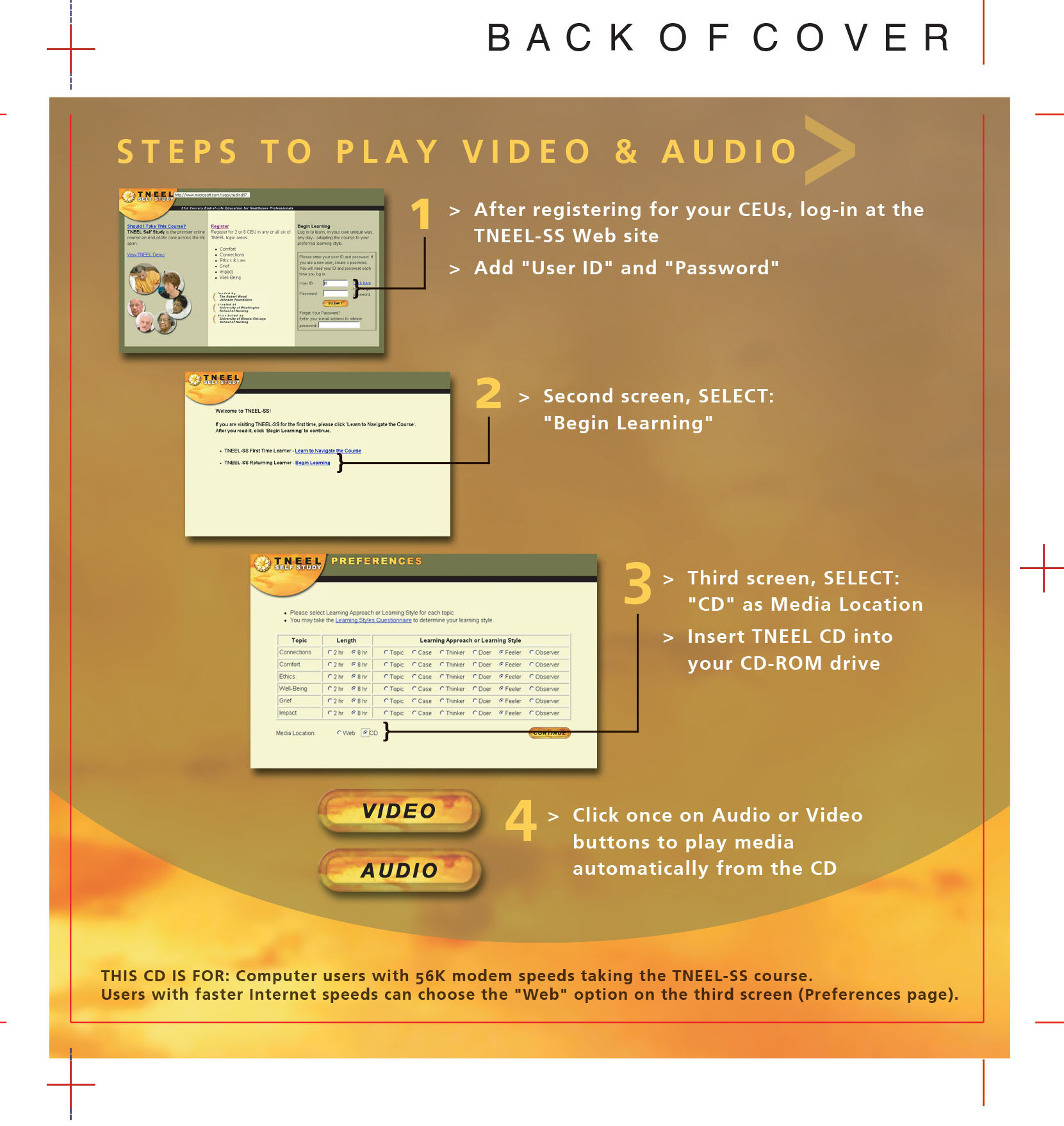
TNEEL SS Online Learning Came with ... a CD-ROM
In order for the high-quality multimedia to work in the low-bandwidth days of yore, we sent out a disc of media to hyperlink to the learning pages. Very retro. TNEEL NE (Nursing Education in CD-ROM form) evolved into TNEEL SS (Self -Study online).


First TNEEL Design: TNEEL-NE Version 1.0
This Jewel Case would set the design standard for the multi-year TNEEL project.

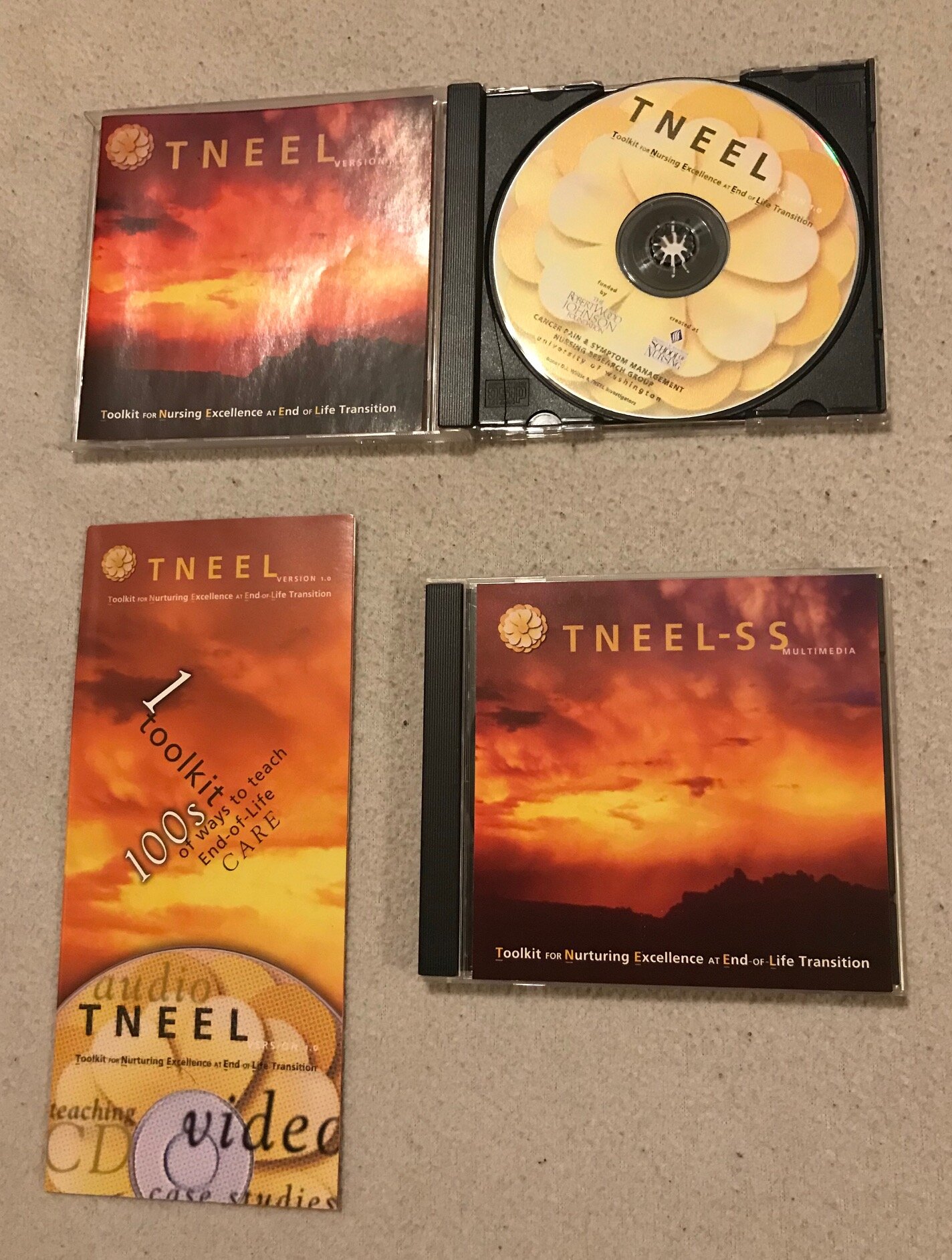
Physical CD-ROM and Print Pieces
Here are some analog print and software CD-ROM pieces I designed, wrote copy for, and facilitated in physical production. They obviously predate the TNEEL SS digital interface for end-of-life learning to earn continuing education credits.
The content itself also wasn’t controlled centrally until TNEEL SS. Basically, educators were encouraged to teach their own courses, no strings attached.
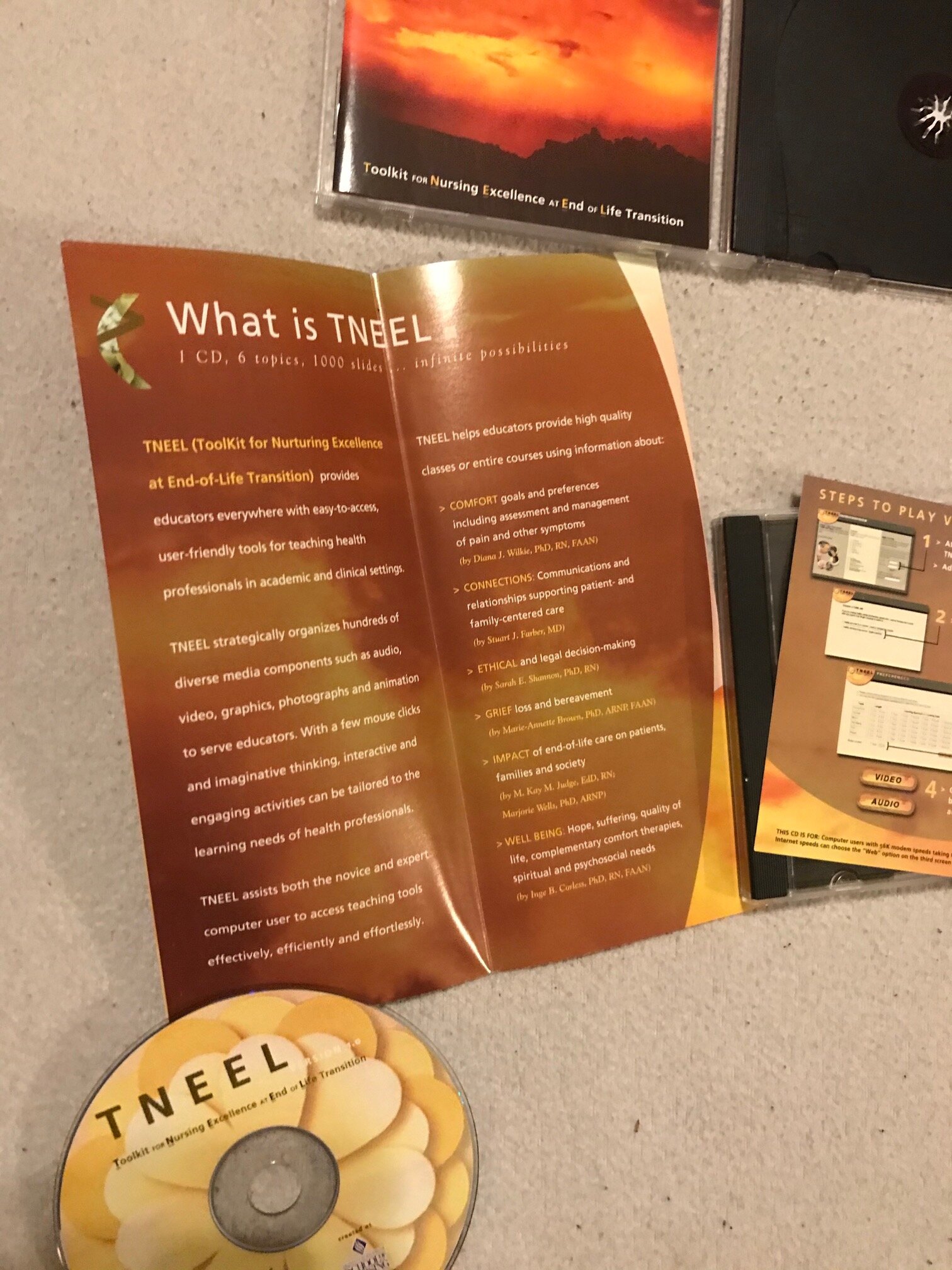

Tens of Thousands of These Showed up in Mailboxes in North America
The grant called for the software product to proliferate everywhere and change how caregivers treated people during the dying process through quality education. We did our very best in a collaborative team, and were hugely successful — this mailer surpassed our expectations in orders. By the end of the decade, more than 14,000 CD-ROMs were delivered.
I came up with all visual concepts, marketing design, and copy.

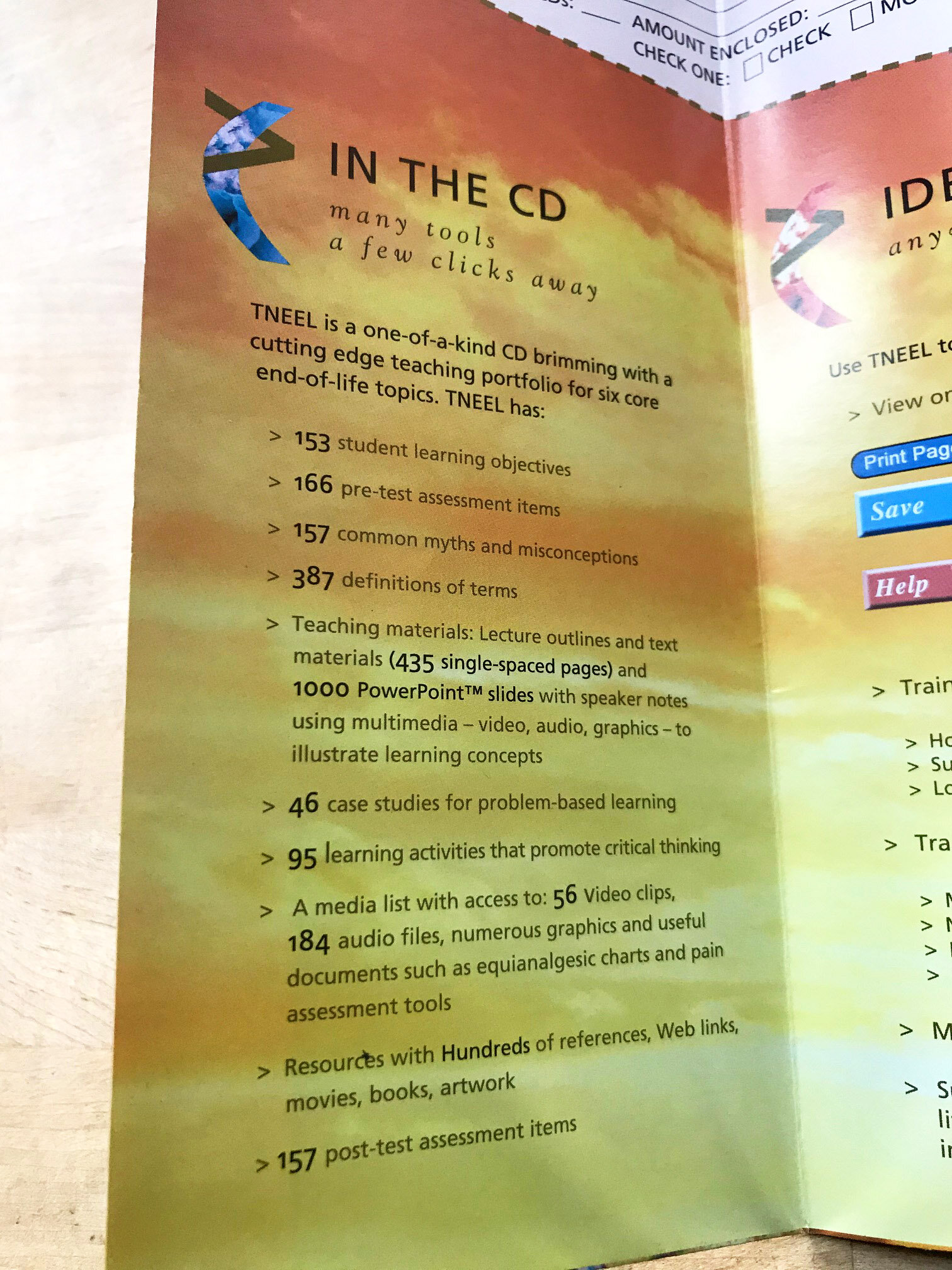


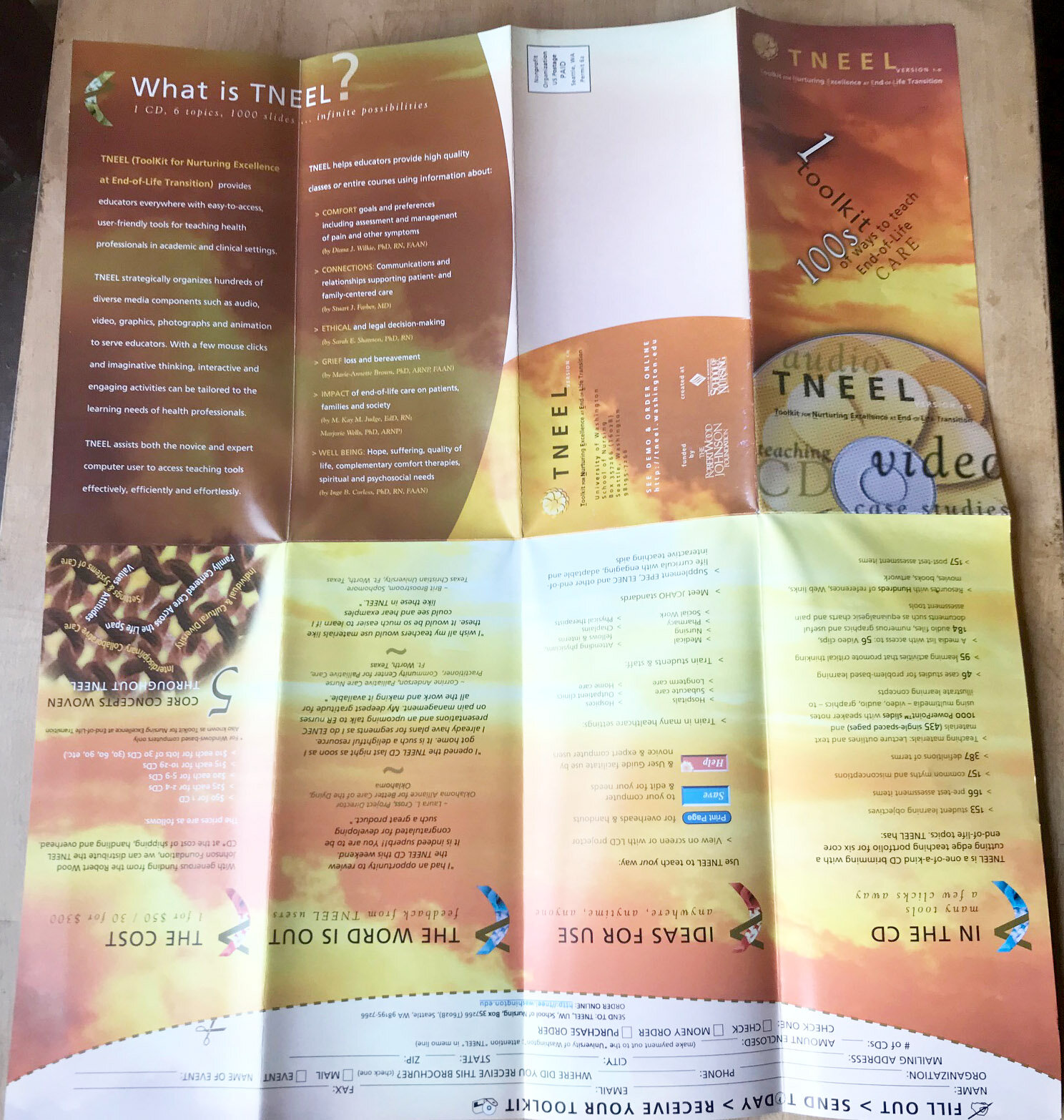

Brochure Folds Out Into Poster and Order Form